

Gumbo’s origin story has no single, confirmed beginning. The history of gumbo in Louisiana can be hard to pin down, especially when Cajun and Creole traditions are blurred together. Its layered roots tell a clearer story: communities brought ingredients and cooking practices together, then made the dish their own.
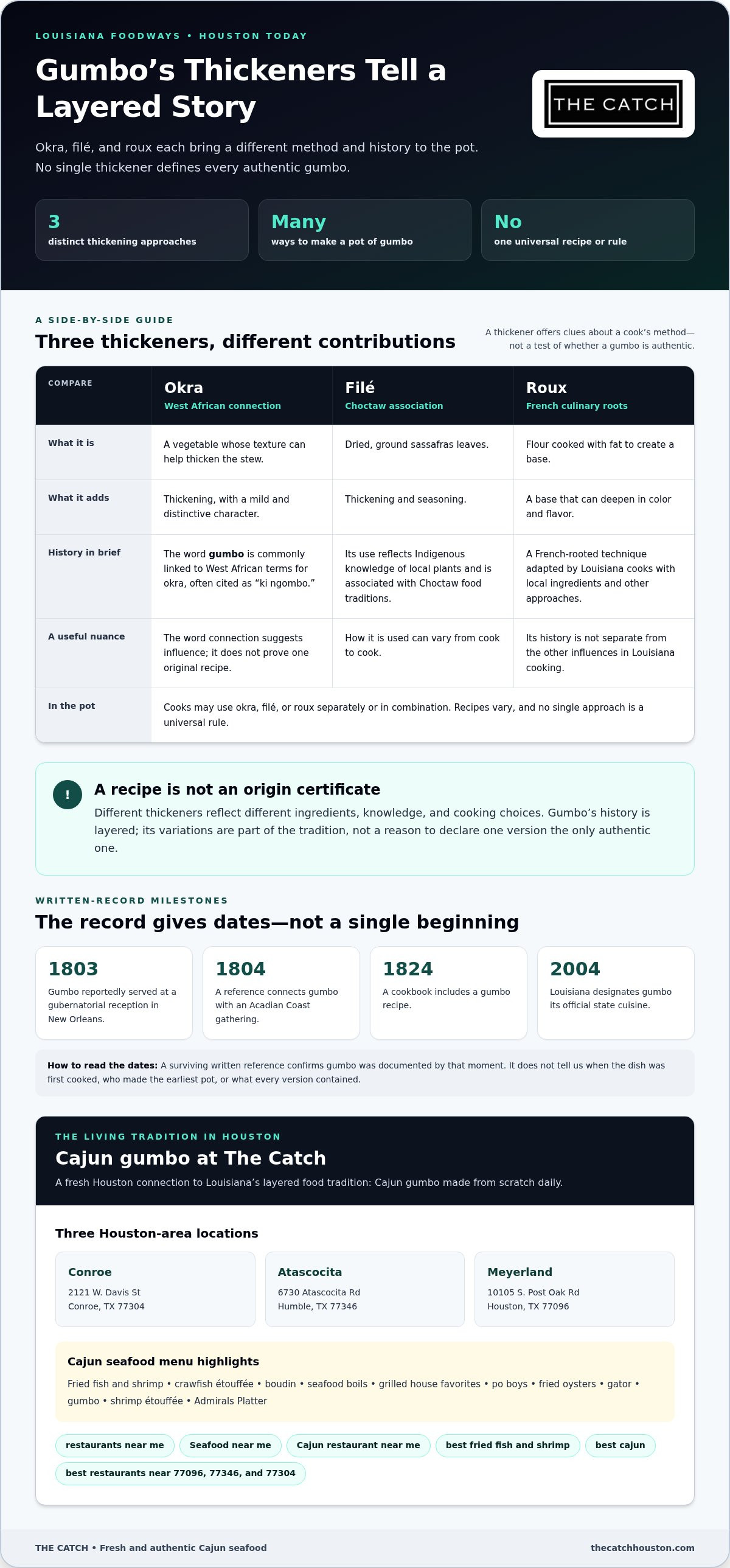
Early written records offer useful milestones: references to gumbo at a New Orleans gubernatorial reception in 1803, an Acadian Coast gathering in 1804, and a cookbook recipe in 1824. These dates don’t identify an inventor. They show how a shared Louisiana tradition took shape through West African, French, Native American, and other cultural influences.
This article traces those influences, explains how Cajun and Creole gumbo can differ, and follows the dish from its early references to its place in modern Houston. It also explains what okra, filé, and roux contribute, and why family recipes can vary without one being the only authentic version. At The Catch, Cajun gumbo brings a fresh Houston connection to that living tradition, made from scratch daily.
Key Takeaways
- The history of gumbo in Louisiana is a shared culinary story, not a dish with one confirmed inventor.
- West African, Indigenous, and European foodways contributed to gumbo’s evolution, without creating one fixed recipe for each culture.
- Okra, filé, and roux offer different ways to thicken gumbo; recipes may use them separately or in combination.
- When weighing origin claims, distinguish dated written records from interpretations about when gumbo or a cooking method first emerged.
- A present-day Houston bowl connects the tradition to local life while reflecting the choices of the kitchen that prepares it.
How Gumbo Became a Defining Dish in Louisiana
Gumbo is a Louisiana stew made in many ways, with ingredients and methods that vary from one pot to the next. Its deep flavor and comforting character have tied it closely to the state, but the history of gumbo in Louisiana doesn’t lead to one inventor or a single, undisputed origin. The surviving record gives us milestones, not a precise birth certificate.
For a closer look at the dish’s history, watch this overview from Tasting History with Max Miller:
What the earliest documented references tell us
Two early references help anchor a Louisiana timeline. Gumbo was reportedly served at a gubernatorial reception in New Orleans in 1803, placing it at a formal public gathering in the state’s largest city. A reference from the following year connects gumbo with an Acadian Coast gathering in 1804. Together, the accounts place the dish in more than one setting: a civic reception and a community gathering.
They don’t tell us when gumbo was first cooked, who prepared the earliest pot, or what every version contained. A written account records what someone documented at a particular moment. It can confirm that a dish was known by then, but it can’t rule out earlier cooking that left no comparable written record. The earliest surviving mention is not automatically the dish’s beginning.
Why gumbo resists a single-origin story
Gumbo’s ingredients and techniques vary across cooks, households, and communities. One pot might lean on seafood, another on meat; seasoning and thickening methods can differ, too. These variations aren’t gaps to solve by declaring one recipe the original. They’re part of how a dish takes root and continues to be made.
Historians and food writers therefore distinguish documented events from interpretations about how the dish developed. A reference to gumbo at a gathering establishes a date and setting, not a complete recipe or an account of invention. The broader overview of gumbo’s diverse origins and evolution also reflects how its history is discussed through multiple cultural influences rather than a single source.
Gumbo’s history is best understood as layered cultural development, shaped over time by cooks and communities rather than created in one moment by one people. That helps explain how gumbo became a Louisiana hallmark without reducing its past to an unsupported origin tale. In 2004, Louisiana designated gumbo its official state cuisine, recognizing a dish whose meaning reaches beyond any one recipe. Its defining quality is not sameness, but the way each pot carries a cook’s choices within a shared Louisiana tradition.
How African, Indigenous, and European Foodways Shaped Louisiana Gumbo
Gumbo’s ingredients tell a story of contact, adaptation, and knowledge carried between kitchens. West African, Indigenous, and European foodways all helped shape Louisiana cooking, but their influence shouldn’t be reduced to a checklist where each culture supplied one fixed part of a finished recipe. Cooks made choices within their communities and circumstances, and those choices changed over time.
That context matters. Louisiana’s food traditions developed amid colonization, forced migration, trade, and the presence of Indigenous peoples whose knowledge of local plants and ingredients long predated European settlement. These histories weren’t equal exchanges. The cultural influences on Louisiana gumbo are best understood by considering both the ingredients and the people who cultivated, prepared, and shared them.
West African foodways and okra
The word gumbo is commonly linked to West African terms for okra, often cited as “ki ngombo.” Linguistic accounts make this a likely connection, not proof of one exact naming moment. Okra also has a practical role in the stew: its texture can help thicken a pot while adding its own mild, distinctive character.
That connection is meaningful, but it doesn’t establish a single original gumbo recipe. The name points toward West African influence in Louisiana’s food history; it doesn’t show that every early version contained okra or that all cooks used it the same way. Ingredients travel, and cooks adapt their uses to local crops, tastes, and available methods.
Indigenous knowledge and European cooking methods
Filé offers another example of knowledge rooted in place. Made from dried, ground sassafras leaves, it is associated with Choctaw food traditions and can be used to thicken and season gumbo. Its presence reflects Indigenous knowledge of local plants, not simply an ingredient added to a European dish. The way filé is used can vary from cook to cook.
Roux, by contrast, has French culinary roots: flour is cooked with fat to create a base that can deepen in color and flavor. In Louisiana, cooks adapted this technique within a distinct regional cuisine, combining it with local ingredients and other approaches. Roux and filé don’t cancel out one another’s histories. A gumbo made with either, or with different combinations, isn’t bound by one universal rule.
Louisiana gumbo was shaped where distinct food traditions met, endured, and changed, not by one culture acting alone. Its ingredients are clues to overlapping histories, not labels that assign every pot to a single origin. For a present-day taste of Cajun gumbo, try a bowl at The Catch, where the restaurant’s current recipe reflects its own kitchen’s choices.
Okra, Filé, and Roux: What Gumbo’s Thickeners Reveal About Its Evolution
A gumbo’s thickener reveals something about the cook’s method, but it can’t identify one universally authentic version. Okra, filé, and roux each help give a pot body, and cooks may use them separately or in combination. Their different origins and uses offer a practical way to understand how gumbo recipes have changed without forcing them into fixed categories.
How okra, filé, and roux differ
Okra adds body as it cooks in the stew. Filé is made from dried, ground sassafras leaves, while roux combines flour and fat cooked together before being incorporated into a dish. These methods aren’t interchangeable in every recipe: each involves its own ingredients and preparation choices.
As discussed in the evolution of gumbo’s ingredients, these thickeners also carry histories connected to different food traditions. Their presence doesn’t turn a recipe into a simple cultural label. A cook might choose a method based on family practice, available ingredients, or the flavor and body they want. Another cook may use a different approach and still make gumbo rooted in Louisiana tradition.
Some recipes use one thickener; others combine methods. The choice doesn’t establish a ranking, and leaving out one ingredient doesn’t make a recipe less genuine. Reading the method as a clue to a cook’s choices is more useful than treating it as an authenticity test.
What historical recipes reveal about variation
A documented cookbook offers a glimpse of this variety. Lafcadio Hearn’s La Cuisine Creole, published in 1885, includes gumbo recipes featuring a range of proteins and examples that use okra or filé. The collection shows that written recipes recorded more than one approach to gumbo. It documents variation in the cookbook’s pages, not every pot being cooked in Louisiana at the time.
That distinction matters. If one recipe in a historical book doesn’t include a particular thickener, it doesn’t prove cooks never used it. Cookbooks preserve selected recipes, not every household’s everyday practice. They show what an author or editor chose to publish while leaving other traditions undocumented.
Cajun and Creole are useful cultural and regional terms, but they don’t divide gumbo into two unchanging formulas. Ingredients, techniques, and family preferences overlap and vary. The history of gumbo in Louisiana is easier to understand when recipes are read as snapshots of particular cooks and moments, not rules for what gumbo must always contain.
That variety continues in present-day bowls. The Catch’s Cajun gumbo includes okra alongside shrimp, crawfish tails, and sausage. It’s a modern kitchen’s combination, not proof of any historical origin. Try a bowl as one contemporary expression of a dish with many approaches.
How to Read Gumbo’s History Without Falling for a Single-Origin Myth
Claims about gumbo’s beginnings can sound certain even when the evidence is partial. A careful reader can separate what a source directly records from what historians infer, then ask whose experience the source represents. This approach makes the story more trustworthy, with room for documented milestones and kitchens that rarely left written records.
A simple way to assess gumbo-origin claims
Start with the evidence behind the claim. Is it tied to a dated document, cookbook, newspaper account, or attributed oral history? Then ask what that source actually establishes. A cookbook may show that a recipe was published by a certain date; on its own, it can’t prove the recipe was invented then or that every household prepared gumbo the same way.
Pay attention to the wording. “The earliest known written reference” describes a record. “Gumbo was invented in…” makes a much larger claim and needs evidence capable of supporting it. Responsible accounts distinguish documented facts from interpretation, using language such as “may,” “likely,” or “is commonly linked to” when the record leaves room for uncertainty.
- Check the source and date. Identify who created the record, when it appeared, and what event or recipe it describes.
- Notice the scope. A published recipe or public gathering offers a snapshot, not a full account of every community’s foodways.
- Question absolute claims. A sole inventor or precise origin date requires stronger evidence than a later written mention.
Terminology needs similar care. The meaning of a food name can shift across time and place, and labels used to describe communities may not match the language people used for themselves. A modern category can help organize discussion, but it isn’t a complete map of a more complicated history.
Why regional and household variations matter
Recipes change as they move between places, generations, and individual kitchens. Cooks adapt to available ingredients, personal taste, family memory, and learned methods. One written ingredient list captures one version; it doesn’t set the boundaries of every gumbo made before or after it.
The same caution applies to Cajun and Creole distinctions. These terms describe meaningful cultural and culinary traditions, but they don’t explain gumbo’s entire development or divide every recipe into two fixed formulas. A household might draw on several influences, and a recipe can evolve without losing its connection to Louisiana.
Variation is evidence of a living food tradition, not proof that one version owns the origin story. Reading the history of gumbo in Louisiana this way keeps regional identity in view without assigning sole ownership. It also leaves space for cooks whose knowledge passed through practice and conversation rather than books. To enjoy a present-day Cajun bowl shaped by its own kitchen’s choices, explore gumbo at The Catch.
Louisiana Gumbo’s Living Legacy in Houston
Gumbo’s story keeps developing wherever cooks bring their own choices to the pot. In Houston, a present-day Cajun bowl offers a local way to enjoy that living food tradition, not proof of how gumbo began or a definitive historic recipe. Diners searching “restaurants near me,” “Seafood near me,” or “Cajun restaurant near me” can find Louisiana-inspired flavors alongside modern kitchen interpretations.
A present-day Houston connection to Cajun gumbo
The Catch is a family-owned restaurant established in 2017, serving Cajun gumbo with shrimp, crawfish tails, sausage, and okra. Crawfish is seasonal. Dishes are made to order and prepared from scratch daily, bringing a fresh-made touch to this hearty bowl. Those details describe The Catch’s current preparation, not historical evidence about gumbo’s origins.
Gumbo is one part of the wider Cajun menu, which also includes seafood boils, fried catfish and shrimp, po’ boys, oysters, boudin balls, red beans and rice, and shrimp or crawfish etouffée. Seafood combo meals, including the Admirals Platter, offer another way to sample the menu. Each dish gives diners a different way to enjoy Cajun flavors in Houston.
Find The Catch in Greater Houston
The Catch’s three Greater Houston locations give diners options in Conroe, Atascocita and Humble, and Houston’s Meyerland area. The restaurants also serve nearby communities including Bellaire and Missouri City. For people comparing the best restaurants near 77096, 77346, and 77304, these addresses help pinpoint a location:
- Conroe: 2121 West Davis Street, Conroe, TX 77304
- Meyerland: 10105 South Post Oak Road, Houston, TX 77096
- Atascocita: Royal Spring Shopping Center, 6730 Atascocita Road, Suite 115, Humble, TX 77346
Each location offers a local connection to Cajun cooking in a fast-casual, family-friendly setting. A present-day bowl can’t stand in for every family recipe or regional tradition, but it can offer a flavorful way to connect with gumbo’s continuing place in Louisiana food culture.
Enjoy this Houston expression of Cajun gumbo by ordering from The Catch online.
Keep Louisiana’s Gumbo Tradition Moving Forward
The next time you sit down to a bowl of gumbo, notice what gives it character and how the cook’s choices shape its flavor. No single recipe can contain every chapter of the history of gumbo in Louisiana. Each bowl is an invitation to appreciate the hands and traditions behind it while making room for new interpretations at today’s tables.
That living connection makes gumbo rewarding: it can carry echoes of the past without standing still. At The Catch, Cajun gumbo is made to order and prepared from scratch daily, bringing fresh Gulf Coast flavor and a welcoming spirit to every bowl. Order Cajun gumbo online from The Catch.
Frequently Asked Questions
What does the word gumbo mean?
Gumbo is commonly connected to a West African word for okra, often rendered as “ki ngombo.” Food-history sources such as the Southern Foodways Alliance discuss this linguistic link while recognizing that a word’s history doesn’t settle the dish’s full story. The name may point to one strand of gumbo’s history, but it can’t prove one exact recipe, identify an inventor, or explain every way Louisiana cooks developed the stew.
Is gumbo older than Cajun cuisine?
Some food-history accounts describe gumbo’s roots as predating the Cajun presence in Louisiana, but that doesn’t provide a precise date for its first preparation. The distinction is between a dish’s broader development and the later histories of particular communities and labels. Early written records show gumbo was known by the time they were made; they don’t establish when it began or make it the creation of one culinary tradition.
Who invented gumbo in Louisiana?
No single inventor is established by the historical record. Gumbo took shape through culinary exchange and changing practices, so assigning its creation to one person or community would flatten a complex story. Distinguish the earliest record researchers can point to from the harder question of when cooks first made versions of the dish. A recipe shared orally may have existed long before it appeared in print.
What is filé powder made from?
Filé powder is made from dried, ground sassafras leaves and is used in some gumbo traditions. Its use is often associated with Choctaw food knowledge, a connection described in Louisiana food-history discussions, including 64 Parishes. In the kitchen, filé is one way to add body and flavor, but it isn’t required in every gumbo. Cooks may instead use okra, roux, or a combination, depending on the recipe.
Did gumbo always contain seafood?
No. Gumbo has included different proteins, and seafood isn’t required for every version. A cook might build a pot around seafood, poultry, or other meats, depending on the household recipe and available ingredients. That range is a reminder to treat a menu description as one specific version, not a template for the dish’s entire past. The Catch’s Cajun gumbo is a restaurant recipe, distinct from historical evidence about gumbo overall.
Why is gumbo associated with Louisiana?
Gumbo is strongly associated with Louisiana because it became deeply embedded in the state’s food culture, with recipes adapted across communities and households. Its name, ingredients, and methods also reflect connections to multiple culinary traditions. That association doesn’t mean gumbo has no history elsewhere or that Louisiana’s story belongs to one group alone. Rather, the state became a central place where gumbo’s many forms gained lasting cultural meaning and recognition.
What is the difference between a historical gumbo reference and gumbo’s actual origin?
A historical reference proves that a document’s author recorded gumbo by a certain time, not that the dish was first created then. To assess a claim, check whether the source is a menu, cookbook, newspaper, or account of an event, and what it actually says. Recipes can circulate through practice and oral sharing before publication, so a dated record marks documented evidence, not necessarily the beginning of the food itself.


